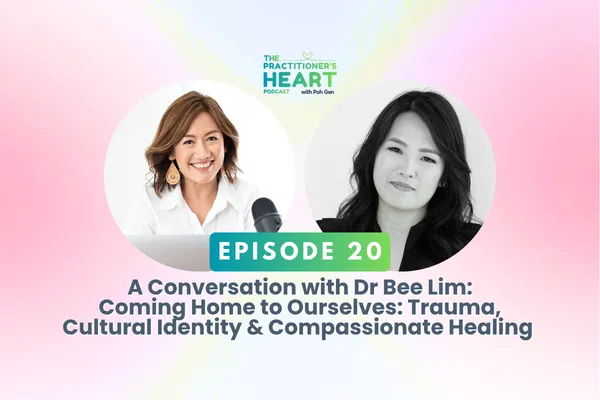
Episode 20: Coming Home to Ourselves: Trauma, Cultural Identity & Compassionate Healing

EPISODE 20
Coming Home to Ourselves: Trauma, Cultural Identity & Compassionate Healing
There's a particular kind of quiet that settles over a conversation when someone is telling the truth about what it costs to belong. That's the quiet I found myself in while talking with Dr Bee Lim, clinical psychologist, EMDR practitioner, and author of Welcome Home: Healing Trauma and Reclaiming Wholeness, for this episode.
Bee and I talked about trauma, yes. But underneath that word was something more specific: the parts of ourselves we quietly set aside so we could survive in places, families, and professions that didn't always make room for all of who we are. For many of us in the Asian diaspora, and for many therapists trained in predominantly Western clinical models, that setting-aside becomes so habitual we stop noticing we're doing it. This post is my attempt to sit with a few of the threads from our conversation a little longer than a podcast episode allows.
The Silence That Isn't Empty
One of the ideas that stayed with me is what Bee calls intergenerational silence, not an absence, but a presence. In many Asian families, silence often carries grief, survival strategy, and love all at once. It's not that nothing was passed down; it's that so much was passed down without words, through the body, through what wasn't said at the dinner table, through the tightness in a parent's shoulders.
For therapists, this matters clinically and personally. A client's "silence" around family history isn't necessarily avoidance or resistance. It may be an inherited form of protection. Naming this distinction, without pathologising it, is one of the quieter, more important shifts we can make in culturally responsive practice.
Cultural Dissociation: Losing Ourselves to Learn the Model
Bee introduced a concept that I think deserves far more airtime in our profession: cultural dissociation. It's what happens when practitioners, particularly those from collectivist or diasporic backgrounds, absorb a clinical training that implicitly treats Western, individualistic frameworks as the neutral default. Over time, we can lose touch with the cultural wisdom, relational values, and embodied ways of knowing we grew up with, simply because the model we were taught didn't have language for them.
This isn't a call to discard evidence-based practice. It's an invitation to ask: whose evidence, and whose body, was this practice built around? And just as importantly, what happens when we let our own cultural inheritance back into the room, rather than leaving it at the clinic door?
The Wolf and the Crane
Bee described two of the four archetypal parts explored in her Homecoming Profile framework, the wolf and the crane and I found myself recognising both instantly, in clients and in myself.
The wolf holds anger, protection, and the instinct to be heard after years of being silenced. The crane intellectualises, observes from a distance, and drifts upward and away from the body when things become too much to feel directly. Neither part is a problem to be fixed. Each one made sense once, a strategy, not a flaw. The work, as Bee describes it, isn't to banish these parts but to understand what they were trying to protect, and to slowly build a relationship with them that no longer requires exile.
If you work with parts-based approaches like IFS, this reframing through a cultural lens is worth sitting with. Whose "wolf" have you asked a client to soften before they felt safe enough to be angry? Whose "crane" have you gently invited back down into the body, rather than naming as dissociation to be corrected?
Grief, Gardening, and the Slowness the Body Needs
One of the most tender parts of our conversation was about ritual, specifically, gardening as a grief practice. There's something instructive in this for those of us who sit with trauma all day. Healing rarely moves in insight-sized leaps. It moves in small, repeated, physical acts: hands in soil, breath in the belly, the same walk taken again tomorrow. Contemplative practice, in this sense, isn't separate from trauma recovery, it's often the very thing that makes recovery bearable and sustainable, for both client and practitioner.
Becoming Future Ancestors
Bee used a phrase that I haven't been able to put down since: future ancestors. The idea that healing work isn't only about repairing what was passed to us, but about consciously choosing what we pass forward, emotional wealth instead of emotional debt, permission instead of silence, wholeness instead of the pressure to constantly prove ourselves enough.
For therapists, this reframes the weight of the work. We are not just treating symptoms in a fifty-minute hour. We are, in small and unglamorous ways, participating in what gets handed down.
A Few Questions to Sit With
If this conversation resonates, I'd gently invite you to carry one or two of these questions into your own reflective practice this week:
What part of yourself did you learn to set aside in order to be seen as competent, credible, or "clinical enough"?
Where in your body do you notice your own wolf or crane showing up — with clients, or in your own life?
What is one small, embodied ritual — not an insight, but a practice — that helps you come back to yourself after a hard day of holding others?
These aren't questions with tidy answers. They're the kind we return to again and again, which is really what contemplative practice is for.
Practising This Together
Conversations like this one with Bee are exactly why I created the Bodhi Inner Path Circle, a contemplative membership community for therapists who want more than a single episode or webinar's worth of reflection. Inside Bodhi, we sit with questions like these together, through meditation, reflective practice, and dharma-friendship with others who understand the particular weight of holding space professionally while also tending to our own healing.
If you're longing for a steady, spiritually grounded place to practise, not alone, but alongside dharma friends who get it, you're warmly welcome to join us.
Disclaimer:
The content discussed in this podcast is for inspiration and educational purposes only. It is not a substitute for therapy or clinical supervision, and our time together does not constitute a therapeutic relationship. Please seek professional support if you are in need.